

WASHINGTON / PERSIAN GULF – Day 1 of the Crisis – In a dramatic escalation just hours after peace talks in Pakistan collapsed, President Donald Trump has ordered the U.S. Navy to enforce a full maritime blockade of all Iranian ports and coastal areas .
The blockade took effect at 7:30 PM EST (approx. 3:00 AM Gulf time), with the U.S. Central Command (CENTCOM) confirming that naval assets are now actively intercepting vessels entering or leaving Iranian territorial waters in the Persian Gulf and the Gulf of Oman .
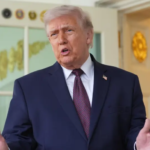
Trump declared on his Truth Social platform that the Iranian navy has already been “completely destroyed,” claiming 158 Iranian vessels now lie at the bottom of the sea. He warned that any Iranian ship that approaches the封锁区 will be “immediately eliminated” .
15 Warships Poised to Strike
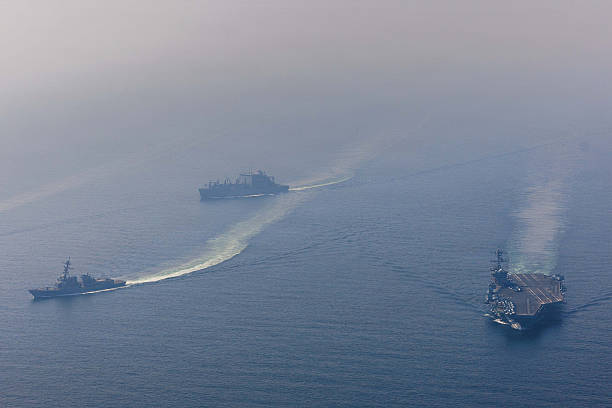
Exclusive new reporting reveals the sheer scale of the U.S. naval power in the region. According to CNN and confirmed by defense officials, the U.S. has assembled a “shock” fleet of at least 15 warships to enforce the blockade .
The Fleet Includes:
-
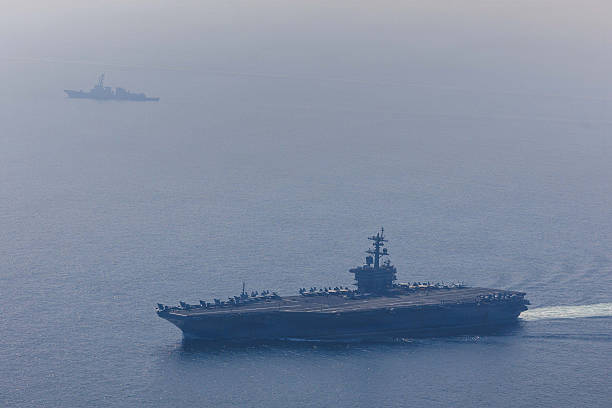
Aircraft Carrier: The flagship USS Abraham Lincoln (CVN-72) , a nuclear-powered supercarrier serving as the command center for air strikes.
-
Destroyer Squadron (11 ships): An unprecedented concentration of firepower including the USS Bainbridge, USS Thomas Hudner, USS Frank E. Petersen Jr., USS Delbert D. Black, USS John Finn, USS Michael Murphy, USS Mitscher, USS Pinckney, USS Rafael Peralta, USS Spruance, and USS Milius.
-
Amphibious Ready Group: The USS Tripoli (capable of launching F-35B stealth fighters), along with the USS New Orleans and USS Rushmore, carrying thousands of Marines .
“President Trump has ordered a naval blockade of the Strait of Hormuz to end Iran’s extortion,” a White House official told the Wall Street Journal, noting that the president “wisely keeps all additional options on the table” .
Why Now? The Collapse of the Islamabad Accords
The blockade is a direct result of the failure of marathon negotiations hosted by Pakistan this weekend .
Vice President JD Vance reportedly walked away from the table after Tehran refused to commit to forgoing a nuclear weapon . While Trump claimed the parties “agreed to a lot of things,” the nuclear standoff proved insurmountable.
“We’re going to get the dust back,” Trump said regarding Iran’s enriched uranium stockpiles. “Either we’ll get it back from them or we’ll take it” .
Trump has given Iran a two-week ceasefire window to come back to the table, warning that if no deal is reached by then, “it won’t be pleasant for them.” When pressed if his earlier threat that “a whole civilization will die” still stands, Trump declined to elaborate, simply stating: “I don’t want to comment on that, but it won’t be pleasant for them” .
The “Minefield” Nightmare
The naval operation is not without immediate physical danger. Just days before the blockade announcement, CENTCOM confirmed that U.S. destroyers entered the Strait of Hormuz to conduct mine-clearing operations .
Tehran had previously issued chilling radio warnings to commercial ships: “You must receive permission from Iranian Sepah navy for passing through the strait. If any vessel tries to transit without permission, will be destroyed” .
Adm. Brad Cooper, commander of CENTCOM, announced that the U.S. is establishing a “safe passage” through the minefields, stating, “We will share this safe pathway with the maritime industry soon to encourage the free flow of commerce” .
Iran responded furiously. The Islamic Revolutionary Guard Corps (IRGC) stated that any military vessel approaching the strait will be treated as a “ceasefire violation,” raising the specter of a direct hit on a U.S. warship .
Global Fallout: Allies Refuse to Join
While Trump claimed that “other countries” have offered their services to help the blockade, key Western allies are running for the exits:
-
United Kingdom: Prime Minister Keir Starmer has firmly ruled out British involvement, stating London will not be “dragged into a conflict with Iran” .
-
Australia: PM Anthony Albanese confirmed Canberra has received no request to participate and emphasized respect for international maritime law .
-
European Union: President of the European Commission Ursula von der Leyen warned of severe economic threats, noting that the closure of the Strait is causing “serious damage” to Europe .
Economic Shockwaves
The Strait of Hormuz handles approximately 20% of the world’s oil shipments . With the blockade now in effect, oil prices have already begun to spike, and insurance rates for tankers are skyrocketing.
The U.S. insists that ships bound for non-Iranian destinations will not be impeded, but the presence of 11 destroyers and a carrier group in the narrow waterway effectively paralyzes movement. Neutral vessels currently in Iranian ports have been granted a limited grace period to leave, but after that, they risk capture or diversion .
What Happens Next?
As dawn breaks over the Persian Gulf, the world watches the most dangerous naval standoff since the Tanker War of the 1980s.
Iran has mobilized its naval forces along the southern coastline, threatening to disrupt other key regional ports if the blockade continues . With Trump weighing the option to resume airstrikes on Iranian infrastructure—including desalination and power plants—the next 48 hours will determine whether the standoff remains a “blockade” or erupts into full-scale war .