

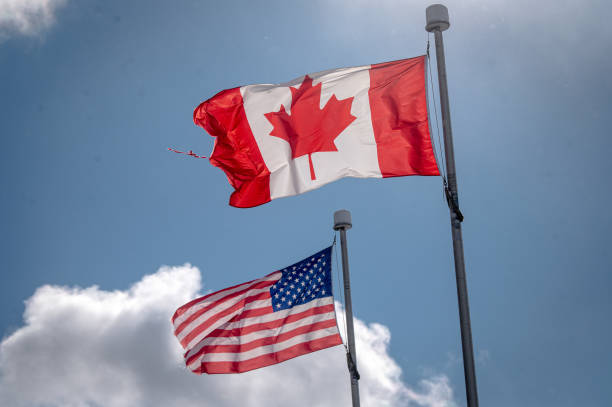


A high-stakes effort to reach a new US-Canada trade deal has collapsed, sending relations between the two longtime economic partners into another period of uncertainty.
Last-minute negotiations between Washington and Ottawa broke down Friday night after weeks of intense discussions. The failure means new 50% U.S. tariffs on roughly $20 billion worth of Canadian goods are now in effect.
Canadian Prime Minister Mark Carney responded by announcing that Canada will impose retaliatory tariffs on American products, matching the U.S. measures “dollar for dollar.” The Canadian tariffs are scheduled to take effect September 8.
The breakdown represents a major escalation in the economic dispute between the two North American neighbors.
Trade Negotiations Collapse at the Final Hour
For much of the week, there had been signs that Washington and Ottawa might reach an agreement.
The two governments had been negotiating intensely after President Donald Trump temporarily delayed the implementation of additional tariffs to give negotiators more time.
As the deadline approached, officials on both sides continued working toward a possible compromise.
That optimism disappeared Friday.
Negotiations ultimately failed, leaving both governments without the trade agreement they had hoped to announce.
The collapse came despite recent statements suggesting that substantial progress had been made.
Trump Administration Moves Ahead With 50% Tariffs
Following the failure of the talks, the United States moved forward with new tariffs of 50% on selected Canadian imports.
The affected products include a wide range of goods, including alcohol, hockey equipment, cement, honey, paper products and certain electronics.
Some important Canadian exports, including energy, potash and fish, are exempt from the latest measures. Existing tariffs covering steel, aluminum, automobiles and lumber remain separate.
The new tariffs represent a significant escalation because of the breadth and size of the duties being imposed on affected products.
Why Did the Trade Talks Fail?
The two governments offered sharply different explanations for the breakdown.
Carney said the United States introduced new terms late in the negotiations that Canada considered unfair and economically damaging.
He argued that Washington was asking Canada to make concessions that would undermine important Canadian interests.
The Canadian prime minister also said the U.S. proposals threatened Canada’s ability to determine its own economic and trade policies.
The United States, meanwhile, has accused Canada of maintaining discriminatory trade practices that disadvantage American businesses.
The competing explanations demonstrate just how far apart the two governments remain.
Carney Promises Dollar-for-Dollar Retaliation
Canada is not accepting the new U.S. tariffs without a response.
Carney announced that Ottawa will impose retaliatory tariffs beginning September 8.
The measures are expected to target American goods in industries including:
- Steel
- Dairy
- Electronics
- Appliances
- Agricultural equipment
- Paper and pulp products
The Canadian government has described the response as a dollar-for-dollar strategy designed to protect Canadian workers and businesses.
The retaliation raises the possibility of a much broader trade confrontation.
Why the Dispute Matters So Much
The United States and Canada have one of the world’s largest bilateral trading relationships.
Trade between the two countries reached approximately $376 billion during the first half of 2026, according to U.S. Census data cited by Axios.
Canada is the United States’ second-largest trading partner, making the dispute particularly important for businesses and consumers on both sides of the border.
A prolonged tariff battle could therefore affect manufacturers, farmers, retailers, transportation companies and consumers.
Businesses Face More Uncertainty
Tariffs increase the cost of imported goods.
Companies that rely on Canadian materials or products could face higher expenses when the new duties take effect.
Some businesses may absorb those costs.
Others could pass them along to consumers through higher prices.
Still others may attempt to find alternative suppliers in different countries.
That process can take months or even years, particularly in industries with highly integrated North American supply chains.
Automobiles Remain a Major Concern
The automotive industry is one of the most closely watched sectors in the dispute.
Canada and the United States have deeply integrated automobile supply chains.
Parts can cross the border multiple times before a finished vehicle reaches a customer.
That means tariffs imposed at different stages of production can have a cascading effect on manufacturers and suppliers.
Automotive trade has therefore remained one of the most difficult issues in negotiations between Washington and Ottawa.
Dairy and Agriculture Are Also at the Center of the Dispute
Canada’s agricultural policies have been another major source of tension.
The United States has repeatedly criticized Canada’s dairy supply-management system and restrictions affecting American agricultural products.
Canada, meanwhile, has defended its agricultural policies as necessary to protect domestic farmers.
The latest negotiations failed to resolve those longstanding disagreements.
Canada’s planned retaliatory measures are expected to target several American agricultural and food-related industries.
The U.S.-Canada Relationship Has Changed
The latest trade dispute is about more than tariffs.
It reflects a broader deterioration in relations between Washington and Ottawa.
For decades, the United States and Canada maintained one of the world’s closest economic and political partnerships.
Cross-border trade became deeply integrated, and companies on both sides built business models around relatively predictable access to neighboring markets.
The current dispute has challenged that assumption.
Carney Says Canada Will Diversify Its Economy
The Canadian government has increasingly emphasized the need to reduce its economic dependence on the United States.
Carney has encouraged Canadian companies to expand into European and Asian markets.
Canada has also pursued additional international trade agreements and investment partnerships.
The strategy reflects a growing belief in Ottawa that the country needs more alternatives if U.S. trade policy remains unpredictable.
Canada Is Preparing for a New Economic Reality
The breakdown in negotiations could accelerate Canada’s efforts to diversify its economy.
Canadian officials have indicated that the country will seek stronger relationships with other international markets while continuing to defend its domestic industries.
The goal is not necessarily to replace the American market overnight.
Instead, Ottawa wants to reduce the economic risks associated with relying so heavily on a single trading partner.
Trump’s Trade Strategy Remains Central
The dispute is also another test of Trump’s broader trade strategy.
The president has repeatedly argued that tariffs can encourage other countries to change trade policies and provide greater advantages for American businesses.
His administration has used tariffs as leverage in negotiations with multiple countries.
The Canada dispute demonstrates both the potential power and the risks of that approach.
Tariffs can create negotiating pressure, but they can also provoke retaliation.
Could the Talks Restart?
Despite the dramatic breakdown, the possibility of future negotiations remains.
Trade disputes between the United States and Canada have repeatedly gone through periods of escalation followed by renewed discussions.
Businesses on both sides have a strong interest in finding a stable long-term arrangement.
The economic cost of prolonged tariffs could eventually encourage both governments to return to negotiations.
However, the latest collapse suggests that any future agreement may require significant compromises.
What Happens Next?
The immediate focus will be on how businesses respond to the new tariffs.
Canadian exporters will have to determine whether they can absorb the higher costs or find alternative markets.
American companies importing affected Canadian products will face similar decisions.
Meanwhile, Canadian officials are preparing their retaliatory measures for September 8.
The next several weeks could therefore be critical for the North American economy.
What Consumers Could Notice
The impact on consumers will depend heavily on which products become more expensive.
Goods that rely heavily on Canadian imports could see price increases if businesses pass tariff costs through the supply chain.
However, not every Canadian product will be affected by the latest measures.
Energy and several other categories have been exempted.
The overall impact will therefore vary considerably between industries and regions.
USMCA Remains an Important Factor
The dispute also comes against the backdrop of the United States-Mexico-Canada Agreement, commonly known as USMCA.
The agreement remains an important framework for North American commerce.
However, the latest tariff measures demonstrate that the existence of a trade agreement does not eliminate disputes between the three countries.
The future of North American trade rules remains an important issue for businesses planning investments and supply chains.
What We Know So Far
The major developments include:
- U.S.-Canada trade negotiations collapsed Friday.
- The two governments had been trying to reach an agreement before a tariff deadline.
- The United States has imposed new 50% tariffs on approximately $20 billion of Canadian goods.
- Some products, including energy and fish, are exempt from the latest measures.
- Existing tariffs on steel, aluminum, automobiles and lumber remain in place separately.
- Canadian Prime Minister Mark Carney announced retaliatory tariffs.
- Canada’s retaliation is scheduled to begin September 8.
- Ottawa says it will respond on a dollar-for-dollar basis.
- Canada is considering measures targeting steel, dairy, electronics, appliances and agricultural equipment.
- The breakdown could further damage one of the world’s most important bilateral trading relationships.
The Bigger Picture
The collapse of the trade talks could mark a turning point in U.S.-Canada economic relations.
For generations, businesses in both countries operated on the assumption that the border would remain relatively predictable.
That assumption is now under pressure.
The two countries remain deeply connected, but the latest confrontation could encourage businesses and governments to reconsider their dependence on each other.
Canada’s push toward international trade diversification could accelerate, while American businesses may increasingly look for alternative suppliers.
The Bottom Line
The US-Canada trade deal has collapsed, triggering a new and potentially damaging phase in the trade relationship between Washington and Ottawa.
The United States has imposed 50% tariffs on approximately $20 billion of Canadian goods, while Canada has promised dollar-for-dollar retaliation beginning September 8.
The dispute comes after weeks of negotiations and follows months of tariff threats and countermeasures.
For businesses, the biggest concern is uncertainty.
For consumers, the question is whether higher tariffs will eventually translate into higher prices.
And for both governments, the larger challenge is determining whether the long-standing economic relationship can be repaired.
The United States and Canada remain deeply connected by geography, trade and decades of economic cooperation.
But the latest breakdown shows that their relationship has entered a much more uncertain era.