

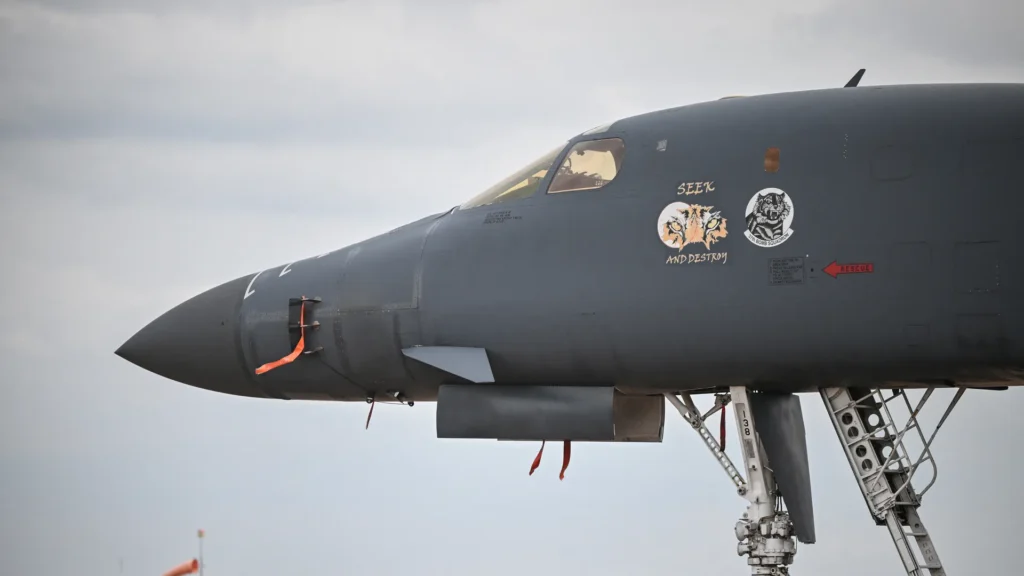

The United States has withdrawn approximately a dozen B-1B Lancer bombers from RAF Fairford in the United Kingdom following heightened security concerns over a potential Iran-linked threat against the military installation.
The sudden redeployment, reported by Axios and subsequently confirmed by the Pentagon, marks a significant security development as tensions between Washington and Tehran continue to shape U.S. military operations in and around the Middle East.
The Pentagon said all U.S. bombers previously deployed to RAF Fairford had returned to their home stations in the United States. Officials emphasized that the move does not eliminate America’s long-range strike capability, with B-1, B-2 and B-52 aircraft remaining capable of conducting missions from the continental United States.
Why Were the B-1 Bombers Moved?
The aircraft were reportedly relocated after U.S. authorities received intelligence indicating a possible threat against the base.
The development follows a series of arrests in the United Kingdom connected to an alleged plot targeting RAF Fairford. British authorities arrested five men near the base in late September, while a sixth person, a dual British-Iranian national, was later detained in London in connection with an investigation into suspected terrorist activity.
No explosives were reportedly found during the initial arrests, and those detained were subsequently released on bail. British counterterrorism authorities have continued investigating the circumstances surrounding the alleged plot.
British officials have indicated that possible foreign-state involvement is among the avenues being investigated. Prime Minister Andy Burnham has said there were indications that Iran may have played a role, while Tehran has denied allegations of involvement.
Trump Says Iran Was Linked to the Threat
U.S. President Donald Trump said Monday that the bombers were moved because of a threat and suggested that the threat was linked to Iran.
Trump said the United States had information indicating a potential danger and argued that moving the aircraft was a relatively inexpensive way to reduce the risk.
Vice President JD Vance similarly described the decision as an abundance-of-caution measure.
However, Secretary of State Marco Rubio offered a more cautious assessment, saying there was no direct connection between the bomber withdrawal and the suspected plot. He said the Pentagon routinely reallocates military resources based on operational requirements.
That distinction is important because investigators have not publicly established that the individuals arrested in Britain were acting directly on behalf of the Iranian government.
Iran has rejected accusations that it was behind the alleged plot.
RAF Fairford’s Strategic Importance
RAF Fairford is one of the United States’ most important locations for deploying long-range bombers in Europe.
Located roughly 90 miles west of London, the Gloucestershire airbase has historically supported U.S. bomber operations and provides a strategically valuable location between the continental United States and the Middle East.
The presence of B-1 bombers at Fairford substantially reduces the distance they would need to travel to reach potential targets compared with launching missions directly from the United States.
The B-1B Lancer is designed for long-range operations and can carry a large conventional weapons payload. Its ability to rapidly conduct long-distance missions makes it an important component of the U.S. Air Force’s conventional strike capability.
What Does the Withdrawal Mean for U.S. Military Operations?
The withdrawal is strategically significant, but it does not mean the United States has lost its ability to conduct long-range strikes.
The Pentagon has stressed that American bomber forces remain ready to conduct precision global strike missions from U.S. territory.
However, moving the bombers back across the Atlantic could increase the logistical demands associated with future operations in the Middle East.
Defense analysts have noted that Fairford provided a useful forward operating location, reducing flight times and potentially lowering some of the aerial-refueling requirements associated with missions launched from the United States.
The United States therefore retains substantial military capability, but the relocation could make some operations more complicated or time-consuming.
A Growing Challenge for Military Bases
The episode also highlights a broader problem facing modern militaries: protecting expensive military assets from relatively inexpensive asymmetric attacks.
Airbases are increasingly vulnerable to drones, sabotage and attacks carried out by small groups operating close to military installations.
The sudden movement of the B-1s demonstrates how intelligence about a potential attack can influence military decisions even before an attack occurs.
Recent conflicts have shown that sophisticated aircraft and other high-value military equipment can be placed at risk by comparatively inexpensive unmanned systems and unconventional tactics.
Britain and the United States Face a Delicate Situation
The development also comes against the backdrop of complicated U.S.-UK discussions over the use of British military facilities in operations involving Iran.
Fairford has been an important location for U.S. military activity, but Britain’s authorization for American operations has included limitations concerning the use of its bases for strikes against Iran. Reuters reported that London had allowed use of Fairford for defensive operations involving Iranian missile threats to ships in the Strait of Hormuz, while refusing permission for offensive strikes against Iran.
That arrangement has underscored the delicate balance Britain faces as a close U.S. ally while attempting to manage its own military and diplomatic interests.
What Happens Next?
The immediate priority for British and American authorities will be determining the nature and credibility of the threat that prompted the bomber withdrawal.
The investigation into the suspected plot remains ongoing, and officials have not publicly released all the intelligence behind the decision.
For Washington, the move also raises questions about where its long-range bombers could be positioned next if commanders determine that a forward operating location is necessary.
Potential alternatives could include other overseas facilities, although any such move would depend on available infrastructure, political agreements, operational requirements and security considerations.
For now, the Pentagon’s message is that America’s bomber force remains operationally ready.
The withdrawal from RAF Fairford therefore represents less a retreat from U.S. military capabilities than a precautionary repositioning in response to an evolving security environment.
Bottom Line
The removal of the B-1 bombers from RAF Fairford underscores the rapidly changing nature of the security threat surrounding U.S. forces and highlights the growing importance of protecting military installations from unconventional attacks.
While U.S. officials have linked the move to a threat associated with Iran, the precise relationship between the alleged plot in Britain and the Iranian government remains under investigation, and Iran denies involvement.
What is clear is that the United States continues to maintain significant long-range strike capabilities—and that the security of overseas bases is becoming an increasingly important consideration in modern military planning.