


President Donald Trump secretly switched aircraft during his return from Turkey after U.S. officials identified what was described as a specific and credible threat from an Iranian proxy group, according to reporting cited by CNN and The New York Times.
The unusual security operation occurred after Trump attended the NATO summit in Ankara.
Trump had arrived in Turkey aboard a newer Boeing 747 that had been donated by Qatar and temporarily designated for presidential travel. However, when he prepared to leave Turkey, he instead departed aboard the older Air Force One aircraft.
The development has raised fresh questions about presidential security, the capabilities of the newer aircraft and how much information was known by people traveling with the president.
A Sudden Change in Trump’s Travel Plans
Trump initially traveled to Turkey aboard the newer aircraft.
However, plans changed when U.S. security officials became concerned about the aircraft’s ability to protect the president in an international threat environment.
Earlier CNN reporting said four U.S. officials indicated that security concerns played a role in the decision to put Trump on the older presidential aircraft. Two officials said security personnel were more comfortable with Trump aboard the older plane.
At the time, the White House publicly offered a different explanation.
Trump said the newer plane was being sent ahead to Europe so U.S. service members could see and tour it.
Later reporting, however, provided a much more serious explanation for the aircraft switch.
Officials Identified a Specific Iranian Threat
According to later reporting cited by CNN, The New York Times reported that U.S. officials had identified a specific and credible threat from an Iranian proxy group operating inside Turkey.
The threat was reportedly directed at Trump and Air Force One.
That revelation dramatically changed the context surrounding the aircraft switch.
What initially appeared to be an unusual logistical decision was instead connected to a presidential security assessment.
The Secret Service reportedly urged Trump to use the older aircraft after assessing the threat.
Why Was the Older Air Force One Considered Safer?
The security concerns centered partly on differences between the two aircraft.
The older Air Force One has sophisticated defensive systems designed to protect the president from a range of threats.
CNN previously reported that the older aircraft has systems capable of helping defend against certain missile threats and protecting against electromagnetic effects associated with a nuclear blast. It was unclear at the time whether the newer Qatar-donated aircraft possessed all of the same capabilities.
That uncertainty became particularly important as tensions with Iran intensified.
The New Qatar-Donated Aircraft Raised Questions
The newer Boeing 747 has attracted significant attention since Qatar offered it to the United States for presidential use.
The aircraft was rapidly retrofitted for presidential operations.
CNN reported that questions had already been raised about whether the aircraft had all of the defensive capabilities required for international presidential travel.
The situation in Turkey therefore created a difficult security calculation.
Even if the aircraft was considered suitable for many presidential missions, officials apparently determined that the older aircraft provided greater confidence in the particular threat environment.
Trump Had Previously Mentioned Iran’s Threats
Trump himself had repeatedly acknowledged that Iran considered him a target.
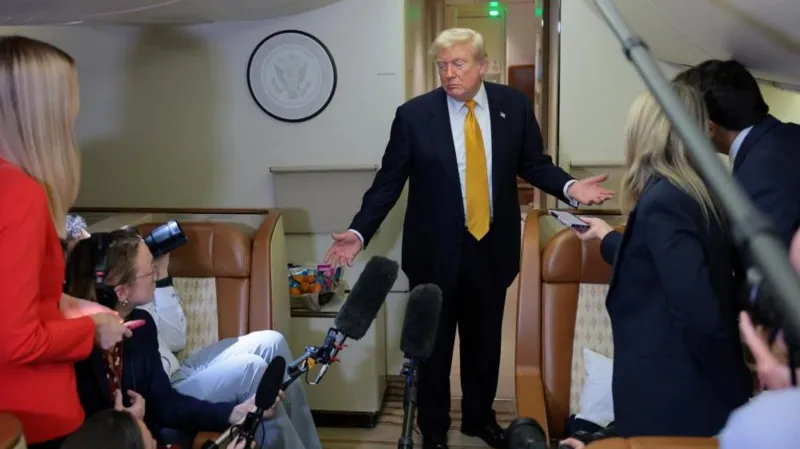
While speaking to reporters during the Turkey trip, Trump was asked whether he knew of a credible Iranian threat against Air Force One.
He responded that he considered himself to be a constant target and said Iran viewed him as its “number one” target.
At the time, however, there was no public confirmation of the specific threat that later became part of the reporting about the plane switch.
The Plane Switch Was Not the End of the Journey
Trump’s unusual travel arrangements did not end in Turkey.
After leaving Turkey aboard the older Air Force One, Trump later switched aircraft again in the United Kingdom.
That second aircraft change added to the mystery surrounding the trip.
The unusual movements were initially explained publicly as part of a plan to allow U.S. service members to see the newer aircraft.
Later reporting suggested that the security circumstances surrounding the president’s travel were considerably more complicated.
A Covert Operation to Protect the President
More recent reporting has revealed even more extraordinary details about the operation.
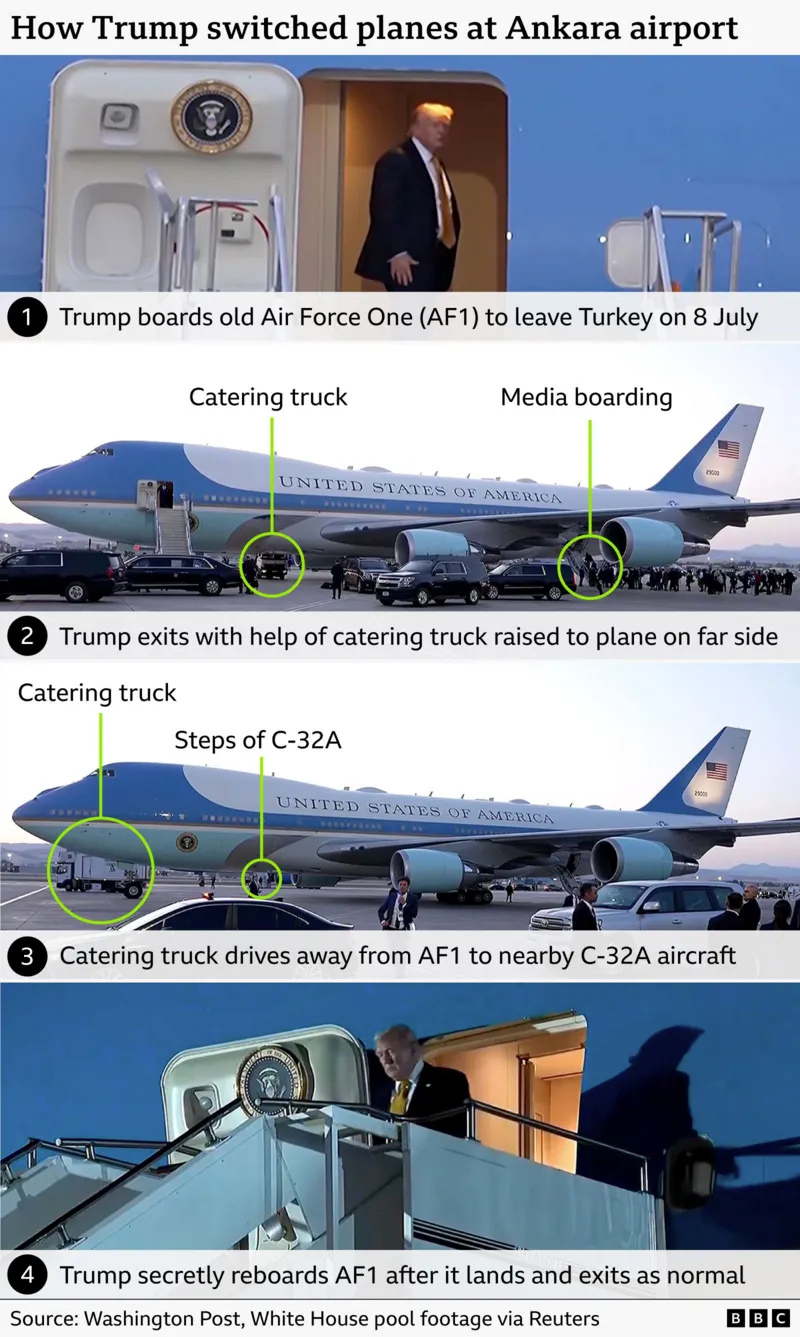
According to reports published in August, Trump was secretly moved from the older Air Force One aircraft to another military jet using a catering truck.
The operation was designed to conceal Trump’s actual location and prevent potential attackers from knowing which aircraft he was aboard.
The aircraft carrying staff and journalists effectively served as a decoy.
That revelation has prompted significant debate about presidential security and the responsibility of officials to warn people who might unknowingly be placed in a dangerous situation.
Why Use a Decoy Aircraft?
The basic security principle is straightforward.
If a hostile actor knows exactly which aircraft is carrying the president, that aircraft becomes a potential target.
By making it appear that Trump remained aboard one aircraft while secretly moving him to another, security officials could make it considerably more difficult to determine his actual location.
The strategy resembles other presidential security measures designed to create uncertainty about a president’s movements.
However, the scale and secrecy of this particular operation have attracted considerable attention.
Journalists and Staff Were Reportedly Kept in the Dark
One of the most controversial aspects of the operation concerns the people who remained aboard the apparent decoy aircraft.
Recent reporting says more than 100 White House staff members and journalists remained aboard the plane without initially knowing that Trump had been secretly moved elsewhere.
That has created an unusual ethical and security debate.
Protecting the president from an assassination attempt is clearly a top priority.
At the same time, critics argue that people knowingly left aboard a potential target aircraft should have been informed of the danger.
White House Faces Questions Over Transparency
The revelation has also raised questions about how the White House communicated the aircraft switch.
At the time, Trump publicly suggested that the newer aircraft had been sent ahead so military personnel could tour it.
Later reporting suggested that the real reason was significantly more serious.
The discrepancy has prompted questions about whether secrecy was necessary to protect the president or whether officials should have provided more information after the immediate threat had passed.
Trump Has Defended the Security Decisions
Trump has generally emphasized that presidential security decisions are made by the Secret Service and military professionals.
He has also indicated that he does not spend much time worrying about threats against him.
The president has repeatedly acknowledged that his position carries significant security risks.
Nevertheless, the latest revelations demonstrate the extraordinary measures that security personnel can take when they believe a credible threat exists.
What Does This Mean for Air Force One?
The incident has also renewed scrutiny of the newer Qatar-donated aircraft.
The plane was expected to provide additional capacity for presidential travel while the United States awaits a new generation of purpose-built Air Force One aircraft.
However, questions remain about the aircraft’s defensive systems and whether it can provide the same level of protection as the existing presidential fleet in every international environment.
Those questions are particularly important when the president is traveling through regions affected by military conflict.
Iran Remains a Major Security Concern
The reported threat comes against a backdrop of sharply increased tensions between the United States and Iran.
Iran has repeatedly been identified as a potential threat to Trump.
U.S. officials have previously warned about Iranian efforts to retaliate against American officials following the killing of Iranian commander Qasem Soleimani in 2020.
The latest reports indicate that concerns about Iranian-linked threats remain an important part of presidential security planning.
What We Know—and What Remains Unclear
Several details are now well established.
What is known:
- Trump traveled to Turkey for the NATO summit.
- He arrived aboard the newer Qatar-donated aircraft.
- He did not leave Turkey aboard that aircraft.
- Security concerns influenced the decision to switch planes.
- Later reporting identified a specific Iranian proxy threat as a major reason for the change.
- Trump was secretly moved between aircraft using a catering vehicle.
- A military aircraft was used to conceal his actual location.
- Journalists and some staff members were reportedly unaware of the deception.
- Trump later continued his journey to Britain and eventually returned home.
What remains unclear:
- The precise nature of the Iranian threat.
- How close the threat was to being carried out.
- What intelligence led U.S. officials to classify the threat as credible.
- Exactly which defensive capabilities were missing or insufficient on the newer aircraft.
- How much senior White House staff knew about the operation.
- Whether additional security measures were taken that have not yet been disclosed.
The Bigger Security Question
The Trump plane switch is more than an unusual presidential travel story.
It highlights the increasingly complicated challenges facing presidential security in an era of drone warfare, long-range missiles, cyber threats and sophisticated intelligence operations.
A president’s location can become a valuable piece of intelligence for hostile governments or armed groups.
Consequently, presidential security teams may deliberately create uncertainty around travel schedules and aircraft movements.
The Trump operation demonstrates just how far those measures can go.
The Bottom Line
The Trump plane switch involving Air Force One was initially explained as a logistical decision.
New reporting has revealed a much more serious security picture.
U.S. officials reportedly identified a credible threat from an Iranian proxy group in Turkey, prompting security personnel to move Trump away from the newer aircraft and onto a more heavily protected presidential jet.
The subsequent use of a catering truck and another military aircraft added another layer of secrecy to the operation.
While protecting the president remains the central objective, the revelation has also created difficult questions about transparency, the safety of staff and journalists and the capabilities of the new presidential aircraft.
As more details emerge, the incident is likely to remain a major topic in the ongoing debate over Trump’s security, Air Force One and the growing threat from Iran.