
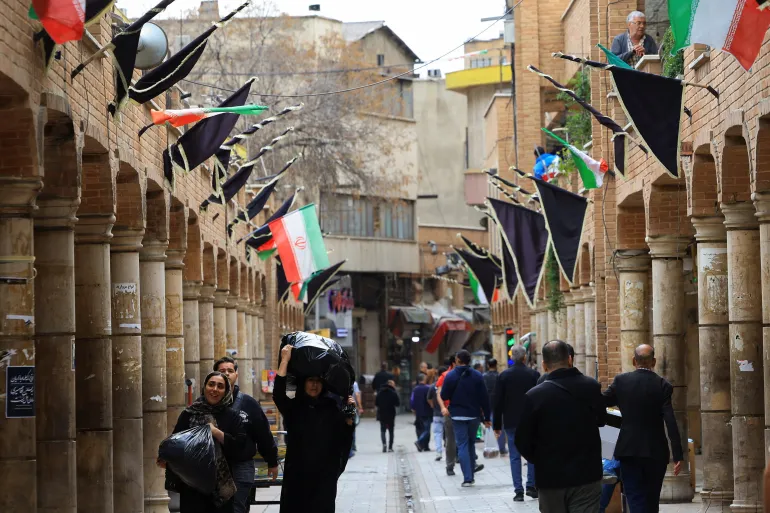

Just before the U.S. Navy began turning back oil tankers from Iranian ports, Tehran was enjoying an unexpected oil boom. In the past month alone, Iran earned nearly $5 billion from crude exports – 40% more than before the war began.
Now, that revenue stream is under direct threat.
President Donald Trump’s naval blockade, which went into effect Monday at 14:00 GMT, has already turned back six vessels in its first 24 hours. But a new analysis from Al Jazeera, citing trade intelligence firm Kpler and maritime data from Windward, reveals just how much Iran stands to lose – and the creative escape routes Tehran may attempt.
The Pre-Blockade Oil Boom, By the Numbers
According to Kpler data:
-
Iran exported 1.84 million barrels per day (bpd) of crude oil in March 2026
-
1.71 million bpd so far in April – both above the 2025 average of 1.68 million bpd
-
55.22 million barrels exported from March 15 to April 14
-
Price per barrel: $90 to over $100 during that period
Even at a conservative $90/barrel, Iran earned $4.97 billion in the past month from oil alone.
Before the war began in late February, Iran was earning about $115 million per day from crude exports – roughly $3.45 billion per month. The war and Iran’s partial closure of the Strait of Hormuz actually increased Tehran’s oil revenue as global prices spiked.
“Iran has some buffer in the form of crude oil reserves in floating tanks, basically parked tankers, which was estimated at about 127 million barrels in February,” said Frederic Schneider, a nonresident senior fellow at the Middle East Council on Global Affairs. “But that doesn’t mean the blockade wouldn’t hurt Iran.”
The Blockade’s Direct Hit
Now, with U.S. warships and over 100 aircraft intercepting vessels leaving Iranian ports, that revenue is in jeopardy.
“Iran would not be able to export oil, at least not at the same level,” Mohamad Elmasry, professor at the Doha Institute for Graduate Studies, told Al Jazeera. “The Iranians also wouldn’t be able to get tolls” from non-Iranian vessels passing through the strait.
According to maritime intelligence agency Windward , as of Monday:
-
157.7 million barrels of Iranian oil were on the water
-
97.6% of that oil was destined for China
-
All of it could be impacted by the U.S. blockade
Beyond Oil: Non-Hydrocarbon Trade at Risk
Iran’s total non-oil trade reached $94 billion from March 2025 to January 2026, according to the Tehran Times. Key exports include petrochemicals, plastics, and agricultural products. Major imports – industrial machinery, electronics, and food – come primarily from China, the UAE, and Turkiye.
If non-hydrocarbon trade is disrupted, analysts warn of domestic shortages in an economy already strained by years of sanctions.
“The question will be whether this increased suffering will force Iran to concede defeat or whether it will harden its resolve and escalate the situation,” Schneider said. “But I doubt this blockade will come into full effect or last very long.”
Iran’s Escape Route: The China Railway
To reduce dependency on the Strait of Hormuz, Iran and China have developed a direct railway link.
Using existing lines across Kazakhstan, Uzbekistan, and Turkmenistan, the first freight train from China arrived in Iran in February 2016. In May 2025, the first train from Xi’an, China, arrived at Iran’s Aprin dry port – marking the official launch of the rail link.
According to geopolitical consulting firm SpecialEurasia , the China-Iran railway “helps mitigate the risks of naval interdiction by Western forces that hamper Iranian trade, particularly the transport of crude oil by Tehran’s so-called ‘ghost ships.'”
However, the report added: “It is important to note that transporting hydrocarbons by rail involves considerable logistical challenges.” There is currently no credible evidence that oil has been transported by rail from Iran to China.
The “Ghost Ship” Factor
Throughout the war, Iran has relied on “dark ships” or “ghost ships” – vessels that switch off their automatic identification system to avoid detection. These ships have continued to transport oil and other goods despite sanctions.
But with over 100 U.S. surveillance aircraft patrolling the Gulf of Oman, even ghost ships may struggle to evade detection.
The China Wild Card
Analysts agree on one major variable: China.
“Most of the Iranian tankers are headed for China, and I cannot see China giving in to this blockade,” Schneider said. “Secondly, I don’t see the U.S. Navy seizing or even sinking these ships.”
That creates a volatile standoff. If Chinese-flagged or Chinese-chartered vessels refuse U.S. orders to turn around, Washington will face a choice: back down, or risk a direct confrontation with Beijing.
What Happens Next?
Schneider summed up the uncertainty: “It’s very difficult to say how serious the U.S. is about this blockade, how long it will last, how it will end and what is coming next.”
Two possible paths:
-
Ceasefire and détente – Iran concedes to nuclear restrictions in exchange for reopened waterways
-
Escalation – Iran retaliates with mines, missiles, or proxy attacks, and the U.S. resumes bombing campaigns
For now, Iran’s $5 billion monthly oil revenue is on hold. The world’s 20% oil chokepoint is effectively closed. And a railway through Central Asia may be Tehran’s only hope.